
Industry News
Stay informed on lubricant market trends, pricing updates, and industry developments. We curate the latest news from trusted industry sources to keep our customers ahead of market changes.
Strait of Hormuz Closure
Ceasefire broke down; Group III supply not expected to normalize before 2H 2027
Market Update (Oct 8):API has extended emergency engine-oil licensing for another 90 days, citing “severe global base oil supply shortages.” South Korea's August base-oil export value jumped 151% on only 5.7% more volume. Group III base oil costs are still working through the supply chain — transaction prices are up more than 230% for the 4 cSt grade, open-market availability has largely disappeared, and synthetic prices are expected to stay firm with further selective adjustments possible, especially on premium grades unlikely to see relief before 2027. Contact us for current pricing and availability.
A JobbersWorld Market Analysis
Group III Costs Are Still Working Through the Supply Chain

The Strait of Hormuz disruption cut Middle Eastern Group III exports more than 70% between March and May. International price signals, government data, and blender economics suggest synthetic lubricant prices will remain firm beyond the short term.
Source: JobbersWorld / Petroleum Trends International, Inc. — Thomas F. Glenn, President & Publisher, with technical review by Steve Haffner, SGH Consulting LLC. Analysis published July 28, 2026; updated August 21, 2026 with the latest BLS Producer Price Index data September 15, 2026 with the Saudi East-West Pipeline disruption, and October 8, 2026 with API's emergency licensing extension and Korean base-oil export data.
Key Takeaways
- The Strait of Hormuz disruption cut Middle Eastern Group III exports more than 70% between March and May 2026. South Korea partially offset the loss, but the shortage of premium approved grades has not been resolved.
- Group III transaction prices rose roughly $8/gal — more than 230% for the 4 cSt grade. Every API base oil group is affected, with increases of roughly 120% to more than 250%.
- Much of that cost has not yet fully worked its way through finished-lubricant prices. Many blenders never fully restored margins lost in the prior cycle, limiting their capacity to absorb more.
- The first signs of recovery are more likely to appear in availability than in price. Premium grades such as 0W-20 dexos 1 are unlikely to see meaningful relief before 2027.
Overview
The collapse in Middle Eastern Group III base oil supply has pushed prices to extraordinary levels and created cost pressures that have not yet fully worked their way through the finished-lubricant market. Market indications for high-performance Group III have approached $13 per gallon— more than three times certain early-year levels. That figure does not represent what every blender pays, and in a market where open-market availability has largely disappeared, it may not represent what any blender can readily secure.
Although Group III and Group III+ are generally produced from petroleum-derived feedstocks, their pricing in the current environment is being driven primarily by supply availability and demand rather than by day-to-day movements in crude oil costs. That distinction helps explain why finished-lubricant prices have moved independently of, and in many cases more sharply than, crude.
The central question for blenders and distributors is not how much Group III prices have increased. It is how much of that increase has already entered finished-lubricant prices, how much remains in the pipeline, and whether additional pricing actions are coming as blenders replace older inventory. The available data point to continued synthetic-price firmness, uneven supplier exposure, and the possibility of further selective adjustments.
Worth noting: It is not only passenger car motor oils that are exposed. Heavy-duty full synthetic and synthetic blend engine oils also contain a significant amount of Group III base oil, so they are subject to the same supply constraints and cost pressure.
How the Supply Corridor Collapsed
The Strait of Hormuz disruption cut the main Group III supply artery to global markets. Combined premium-grade base oil imports from Bahrain, Qatar, and the United Arab Emirates into Asia, Europe, and the United States fell below 50,000 metric tonnes in May, down from more than 185,000 metric tonnes in March. The Middle East had been supplying close to 210,000 metric tonnes per month — including more than one-third of Europe's Group III supply and more than 40% of U.S. imports.
South Korea moved to fill part of the gap, with exports to the United States reaching approximately 85,000 metric tonnes in May and 68,500 metric tonnes in June. Even so, combined Korean and Middle Eastern shipments have remained below the volumes the two regions supplied to the United States in 2025, and the shortage of premium-approved grades has not been resolved. Some industry sources suggest supply may not return to pre-conflict levels before the second half of 2027.
Group III Supply Corridor: The Middle East Collapse
Combined premium-grade base oil exports from Bahrain, Qatar and the UAE to Asia, Europe and the U.S. (000 metric tonnes/month). Volumes fell more than 70% between March and May 2026. South Korea partially offset the loss — exports to the U.S. reached ~85,000 MT in May and 68,500 MT in June — but the shortage of premium approved grades has not been resolved. Source: JobbersWorld/PTI analysis of trade data.
How Base Oil Prices Have Moved Across All API Groups
The disruption has lifted prices across every API base oil group, but the magnitude has varied considerably. Representative U.S. transaction prices have risen sharply since January, with percentage increases ranging from roughly 120% to more than 250%, depending on the group and grade. Group I and Group II have risen approximately $3.50 to $4 per gallon at mid-market, and the smaller Group II+ segment is estimated to be up approximately $4.40 per gallon.
Group III transaction prices have experienced the most dramatic escalation. The 4 cSt grade moved from the low-to-mid-$3 range before the conflict to more than $11 per gallon by mid-July, an increase of roughly $8 per gallon. The heavier 6 cSt and 8 cSt grades rose even more steeply. Some current Group III postings also carry announced forward adjustments, suggesting the current cycle may not yet have peaked.
How Base Oil Prices Moved Across All API Groups
Approximate increase in representative U.S. transaction prices, January to July 2026 ($/gal). Percentage increases ranged from roughly 120% to more than 250% depending on group and grade. The Group III 4 cSt grade rose from the low-to-mid-$3 range to more than $11/gal; heavier 6 cSt and 8 cSt grades rose even more steeply. Group II+ is interpolated. For illustrative purposes only.
What Blender Economics Show
Available blender-reported data show realized Group II base oil cost increases ranging from approximately $2.50 to $4 per gallon, depending on supplier, contract coverage, and region. Group III increases varied more widely — from the mid-single digits for blenders with strong Gulf Coast contract coverage to roughly $8 per gallon for those reliant on East Coast, Canadian, or supplemental sources. Blenders also faced several rounds of additive increases that cumulatively exceeded 20% in some cases.
The range in Group III cost experience reflects in part the near-disappearance of open-market availability since the Hormuz disruption. Finished-lubricant pricing patterns tracked by JobbersWorld showed cumulative spring increases of roughly $6 per gallon for conventional products, while full-synthetic increases generally ranged from $7.50 to $8.50 per gallon. Actual results varied by company, supply source, contract coverage, and product mix, but the directional pattern was consistent across the sector.
Common Lubricant Additives
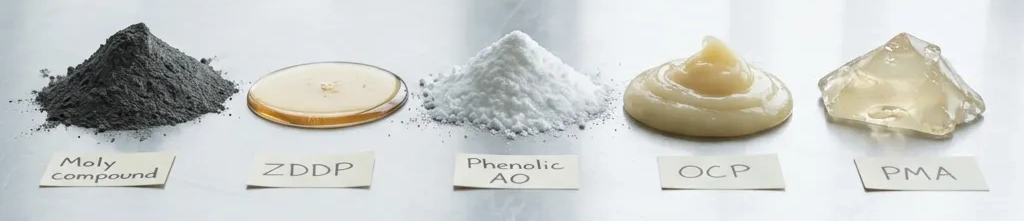
From left: Moly Compound (anti-wear), ZDDP (anti-wear/antioxidant), Phenolic AO (antioxidant), OCP (viscosity modifier), PMA (pour point depressant). Additive increases cumulatively exceeded 20% in some cases.
The Increases Appear to Have Been Primarily Cost Recovery
The relationship between base oil costs and finished-lubricant pricing becomes clearer at the formulation level. In an illustrative 0W-20 full synthetic, the estimated main-base-oil contribution — predominantly Group III or Group III+ — rises from approximately $3.30 to $10.15 per finished gallon, an increase of approximately $6.85. Including the illustrated additive increase brings the estimated total input-cost increase to approximately $7.30 per gallon before accounting for packaging, freight, manufacturing, inventory-carrying costs, and other expenses.
JobbersWorld's spring-cycle tracking showed full-synthetic finished-product increases generally falling in the range of approximately $7.50 to $8.50 per gallon. Against that range, the illustrated $7.30-per-gallon input-cost increase leaves limited room to cover the remaining expenses. The spring pricing cycle appears to have been primarily an effort to recover rising costs rather than expand margins — and in Group III-intensive products, some blenders may remain short of fully recovering their replacement costs.
Cost Recovery Check — 0W-20 Full Synthetic ($/gal increase)
Illustrative January-to-July change for a representative 0W-20 full synthetic. The main base oil contribution (predominantly Group III/III+) rose from about $3.30 to $10.15 per finished gallon (+$6.85); including additives, total input cost rose about $7.30/gal. JobbersWorld tracked finished full-synthetic increases of roughly $7.50–$8.50/gal — leaving little room beyond cost recovery. Illustrative only.
Key Impact:Even if crude oil prices fall, that does not automatically solve constraints in approved Group III barrels. Customers may reasonably ask why motor oil prices are not falling when crude is down — the answer is that, for many modern synthetics, the binding constraint is not crude alone. It is the availability and replacement cost of approved Group III base stocks.
The Cost Cycle in Historical Context
The current divergence between input costs and finished-product pricing is not unique to 2026. During the 2021–2022 supply-chain crisis, the Producer Price Index for petroleum lubricants surged more than 118% from its January 2020 level, while the Consumer Price Index for motor oil rose approximately 66% over the same period. The gap indicates that finished-product prices did not rise as rapidly as lubricant input prices, placing pressure on margins across the channel.
When costs fell in 2023, blenders had an opportunity to recover part of that lost margin. That recovery period is now over. Bureau of Labor Statistics data through mid-2026 show the PPI turning sharply upward again. Many blenders entered the current crisis without having fully restored the margins lost during the previous cost cycle, so their capacity to absorb further increases without passing them on may be more limited than it was four years ago.
Input Costs vs. Finished Prices: BLS PPI vs. CPI (2020–2026)
U.S. Bureau of Labor Statistics, indexed to January 2020 = 100. In 2021–2022 the PPI for petroleum lubricants surged more than 118% while the CPI for motor oil rose about 66% — input costs outrunning finished prices and compressing margins. Costs eased in 2023–2025, then the PPI turned sharply upward again through mid-2026. Intermediate points illustrative. PPI: WPU0573; CPI: CUUR0000SEHE01.
Government Data Confirm the Divergence: Base Stocks Surging Ahead of Finished Lubricants
The latest Producer Price Index data from the U.S. Bureau of Labor Statistics reinforce the picture painted throughout this report: base stock prices have surged well ahead of finished lubricants. The BLS lubricating oil base stock index more than doubled from March through July, and on a year-over-year basis base stock prices were up 95.7% in July. The broad BLS Finished Lubricants index rose on the same path but far more gradually — up 15.0% year over year.
Normalizing both series to January 2025 = 100 makes the gap clear: by July 2026 the base stock index stood at roughly 185 (about 85% above its January 2025 level), while the finished lubricant index reached roughly 115 (up about 15%). On a seasonally adjusted basis, the base stock index rose 26.0% in April and 50.3% in May before easing to 6.9% in June and 8.2% in July.
+95.7%
Base stock index, YoY (July)
+15.0%
Finished lubricants, YoY (July)
+50.3%
Base stock, May (SA, m/m)
~+85%
Base stock vs. Jan 2025
~+15%
Finished vs. Jan 2025
+24.2%
Retail motor oil, Aug vs. Feb
Important context: The BLS Finished Lubricants index is a broad producer-price aggregate — not a measure of distributor acquisition costs, marketer selling prices, or retail shelf prices. Many specific finished products have risen substantially more than the broad index suggests. A JobbersWorld review of 97 comparable motor oils found retail prices collectively 24.2% higher in August than in February, indicating a substantial portion of the pricing cycle has already reached the consumer shelf.
Source: U.S. Bureau of Labor Statistics, Producer Price Index commodity series WPU057801 (Lubricating Oil Base Stocks) and WPU0576 (Finished Lubricants), via JobbersWorld analysis, August 21, 2026. Index levels use not-seasonally-adjusted data; monthly percentage changes are seasonally adjusted and subject to revision.
What Comes Next
The spring pricing actions were calculated while costs were still rising, so some increases may have been based on a cost structure that was already becoming outdated by the time the new prices took effect. For blenders now replenishing inventory, current acquisition costs may be higher than those used to set the first three rounds of increases, while others remain partly protected by contracts or lower-cost inventory. The result is a less synchronized market, with pricing pressure varying significantly by supplier.
The conditions for further pricing action remain in place, though the next phase is unlikely to look like the spring cycle. Rather than broad, simultaneous announcements, distributors may see supplier-specific adjustments, larger increases on selected synthetic products, reduced discounts, tighter terms, or continued allocation on premium grades. Full-synthetic pricing is likely to remain firmer than conventional pricing, and price differences among competing synthetic products at the same viscosity may widen as the market reveals which suppliers carry the greatest Group III exposure.
The environment also remains volatile. The Iran ceasefire that briefly lowered oil prices in June subsequently broke down, and Brent crude crossed $100 per barrel on July 23before a pause in U.S.–Iran strikes caused prices to retreat by more than $10 per barrel. Crude moving $10 or more within days reflects a market that has not found a stable equilibrium — and the decline in crude does not resolve the underlying Group III shortage.
New Development: Saudi Export Disruption Adds Fresh Risk to Feedstock Costs
A disruption to Saudi Arabia's roughly 1,200-kilometer East-West Pipeline has added another layer of uncertainty to crude and refinery-feedstock markets already under pressure from Middle East supply constraints. The line carries crude from the Kingdom's eastern producing region to the Red Sea port of Yanbu, allowing exports to bypass the Strait of Hormuz— a route that has become especially important as Hormuz shipping has been sharply reduced. Reuters reported that attacks forced Saudi Arabia to shut the line, subsequently affecting crude movements from Yanbu, with some European cargoes cancelled as buyers assessed alternatives.
Crude prices moved sharply higher in response. Assessments of how quickly service resumes differ: U.S. Energy Secretary Chris Wright said September 15 he expected oil to flow again within days, while other sources indicated repairs could take several weeks, with partial operations possible before full restoration.
$108.75
+$3.07
Brent, Sept 15 settle
$105.83
+$4.44
WTI, Sept 15 close
4–5M
barrels/day
Pipeline throughput
Days–weeks
conflicting reports
Reopening timeline
What it means for lubricants: There is no evidence at this point that the outage has reduced base-oil production or finished-lubricant supply. The principal risk is to refinery-feedstock economics— higher replacement-crude costs, changes in refinery crude slates, and added freight could pressure base-oil replacement economics if the disruption persists. With Group III availability still tight, the market has less room than usual to absorb another sustained increase in feedstock costs. For now this is best viewed as an upstream risk to watch rather than a confirmed base-oil supply event.
Source: Reuters reporting on the Saudi pipeline disruption and crude-market response, September 14–15, 2026; JobbersWorld analysis of potential lubricant-market implications, September 15, 2026.
October Update: API Extends Emergency Engine-Oil Licensing Another 90 Days
In an October 1 notice, the American Petroleum Institute extended Emergency Provisional Licensing (EPL)for ILSAC and API engine-oil service categories for another 90 days. API said the Middle East conflict has disrupted supply from multiple regional base-oil refineries, causing “severe global base oil supply shortages” that still meet the requirements of Section 6.9 of API 1509. API 1509 states that this relief will “rarely be granted.”
EPL is not blanket permission to use whatever base oil is available. Each licensee must give API technical information that supports any substitute base oil or component made unavailable by force majeure, then sign an EPL Agreement. The license lasts only until the licensee finds alternative supply, completes other API requirements, or the disruption ends. After that, the marketer must return to the original formulation or license a new one that has passed all required testing.
- March 2026EPL activatedAPI activates EPL at ILMA's request after finding that Middle East base-oil conditions meet the force majeure threshold.
- June 2026First 90-day extensionRelief continues into September as Gulf refinery outages persist.
- October 1, 2026Second 90-day extensionAPI again cites disruptions at multiple Middle East base-oil refineries, more than six months after activation.
Read this carefully: API has not disclosed how many companies have applied for EPL, how many formulations are involved, or what substitutions are being made. Many marketers may be able to rely on existing approved sources or on base-oil interchange and viscosity-grade read-across rules instead. So the extension does not mean many finished oils are being made under emergency licenses. It does show that API still considers the supply disruption severe and industry-wide.
Source: JobbersWorld summary of API's October 1, 2026 notice to EOLCS licensees and related provisions of API 1509 (24th Edition, July 2026, amended September 23), published October 2, 2026. This is not a substitute for API's official requirements.
Korean Export Data: Value Up 151%, Volume Up Only 5.7%
South Korea, home to major Group III suppliers including SK Enmove and S-OIL, has been the main partial offset to lost Gulf supply. Its August export figures show how much pricing pressure has come with this year's disruption. According to Korea Petroleum Association statistics reported October 7 by Herald Business, Korea exported $662.87 million of base oil in August, up 151.4% from a year earlier, while volume rose only 5.7% to 2.182 million barrels.
In other words, Korea earned far more per barrel without shipping many more barrels. Compared with February, before the March disruption to Gulf supply, August volume was 24.5% higher but value was 230.6% higher.
+151.4%
$662.87M
August export value vs. Aug 2025
+5.7%
2.182M barrels
August export volume vs. Aug 2025
~$303.8
per barrel (~+138% YoY)
Average unit value, August
$114.4
per barrel, pre-disruption
Average unit value, February
Important context:These are aggregate base-oil exports, which also include S-OIL's Group I and Group II output. They are not a Group III price benchmark, a measure of producer margins, or a U.S. landed cost. Average unit values also change with grade mix, destination, and contract terms. Higher Korean export revenue does not mean the specific grades buyers need have become easier to secure. Fourth-quarter costs will depend on current supplier offers, contract pricing, freight, and inventory.
Source: Korea Petroleum Association statistics reported by Herald Business, October 7, 2026; JobbersWorld calculations, published October 8, 2026.
What This Means for Our Customers
Supply is still tight, and more than six months in, API is still treating it as an emergency. The best protection is to make every gallon go further and to plan purchases early. These resources can help:
- Oil AnalysisConfirm your oil is protecting your equipment, especially if a product or formulation changes, and catch problems before they turn into failures.
- Drain Interval CalculatorSafely extending drain intervals backed by oil analysis cuts how many gallons you buy while prices stay high.
- Understanding Base OilsLearn how Group I, II, III and PAO base oils differ, and why Group III supply drives synthetic pricing.
- Heavy-Duty Motor OilsReview API CK-4 and FA-4 options, including synthetic blends that can reduce your exposure to Group III.
Substitution Is Constrained — and New Risks Are Emerging
The substitution response that normally moderates high prices is limited. Many lower-viscosity licensed formulations cannot simply switch base oils without technical review, reformulation, requalification, or additional testing. Group II+ can relieve pressure in some formulations but replaces only a limited portion of the required Group III. The other primary alternative, polyalphaolefin (PAO), has been reported as largely sold out and unavailable to most participants beyond existing contracts.
This constraint is particularly acute for 4 cSt Group III, which high-end low-viscosity products require to meet viscometric specifications. Industry sources suggest SAE 0W-20 dexos® 1 and premium European-specification products are unlikely to see meaningful price relief before 2027. A further risk has emerged outside Hormuz: the Houthis' declared naval blockade against Saudi Arabia began affecting vessel movements on July 21, and reduced traffic through the Bab el-Mandeb chokepoint threatens one of the few remaining outlets for Saudi oil — adding another layer of supply risk the market has limited capacity to absorb.
Why PAO Offers Limited Relief — Group III vs. PAO 4 cSt ($/gal)
Before the conflict, PAO 4 cSt was roughly three times the contract price of Group III 4 cSt (about $9.60 vs. $3.40/gal). The disruption narrowed the gap as Group III approached $11.40/gal, but PAO is largely sold out and unavailable beyond existing contracts. January PAO discounted 20% to reflect contract pricing; July PAO reflects estimated spot-level indications. Illustrative only.
The bottom line for distributors and customers:the pricing environment is likely to remain unsettled for longer than a synchronized cycle would suggest, with some suppliers still working through cost recovery while others have already moved. The first signs of recovery are more likely to appear in availability than in price — and setting that expectation early is the single most useful thing we can do for our customers.
Latest Price Increase Announcements
Updated: July 29, 2026Source: JobbersWorld - Lubricant Price Adjustments
Upcoming Announced Increases
Further selective adjustments remain likely.The next phase is unlikely to resemble the broad, simultaneous spring rounds. Instead, expect supplier-specific adjustments, larger increases on selected synthetic products, reduced discounts, tighter terms, or continued allocation on premium grades as blenders replace lower-cost inventory at today's higher acquisition costs. Full-synthetic pricing is likely to stay firmer than conventional, and Group III–intensive grades such as 0W-20 dexos® 1 are unlikely to see meaningful relief before 2027. The first signs of recovery are more likely to appear in availability than in price.
Currently In Effect
| Company | Increase Amount | Effective |
|---|---|---|
| HF Sinclair (Petro-Canada Lubricants US & Canada) | Up to 25%, with some products outside stated range | June 10, 2026 |
| TotalEnergies Marketing USA | Mineral: +$2.60/gal; Greases: +$0.29/lb; Synthetics: +$3.70/gal | May 26, 2026 |
| Highline Warren | Group II: up to $2.40/gal; Group III: up to $3.00/gal | May 22, 2026 |
| Omni Specialty Packaging | Synthetic: +$3.00/gal; Other Oils: +$2.40/gal; Brake/AF: +$1.00/gal | May 22, 2026 |
| Martin Lubricants | Up to 26%; allocations in effect for PCO, HDO, SynGard | May 22, 2026 |
| Castrol Automotive & Heavy-Duty | Up to 15%, with some products higher | May 20, 2026 |
| AOCUSA | Synthetic: +$3.70/gal; Blend: +$2.60/gal; Conv: +$2.20/gal; Grease: +$0.25/lb | May 18, 2026 |
| Chevron | Up to 30% across lubricating oils, greases, and coolants | May 18, 2026 |
| Martin Lubricants | Up to 15% (SynGard, Xtreme, Gard brands) | May 8, 2026 |
| ExxonMobil | Up to 30% | May 4, 2026 |
| Petro-Canada Lubricants (Canada) | Up to 35% | May 4, 2026 |
| HF Sinclair / Petro-Canada (U.S.) | Up to 35% | May 4, 2026 |
| Shell (SOPUS) | Up to 25% (Non-Janus pricing) | May 1, 2026 |
| Castrol (BP Lubricants USA) | Up to 15% (excludes select products) | May 1, 2026 |
| CAM2 International | Economy: $3.50/gal; Synthetic: $5.00/gal; Other: $4.00/gal | Apr 27, 2026 |
| ALS | Additional adjustment (product-level details not disclosed) | Apr 27, 2026 |
| Chevron | Up to 25% | Apr 24, 2026 |
| Omni Specialty Packaging | +$3.75/gal non-synthetic; +$5.00/gal synthetic | Apr 21, 2026 |
| Highline Warren | Group II: up to $2.74/gal; Group III: up to $3.00/gal; national branded up to 30% | Apr 20, 2026 |
| Phillips 66 | Up to 35% | Apr 20, 2026 |
| TotalEnergies Marketing USA | Up to 15% (mineral oils & greases); up to 18% (synthetics) | Apr 20, 2026 |
| CITGO Petroleum Corporation | TBA | Apr 20, 2026 |
| Petro-Canada Lubricants (Canada) | Up to 10% | Apr 20, 2026 |
| ALS | 10%–15% | Apr 20, 2026 |
Initial Price Increase Announcements (as of 3/27/26)
| Company | Product | Increase | Effective |
|---|---|---|---|
| Chevron (US) | Certain Products | Up To 15% | Apr 1, 2026 |
| ExxonMobil (US) | All Lubricants & Greases | Up To 12% | Apr 15, 2026 |
| Petro-Canada (US) | All Lubricants & Greases | Up To 15% | Apr 13, 2026 |
| Shell (US) | All Lubricants & Greases | Up To 15% | Apr 15, 2026 |
| Phillips 66 (US) | All Lubricants & Greases | $0.65-$0.85/gal | Apr 1, 2026 |
| Calumet | All Lubricants & Greases | Up To 20% | Apr 4, 2026 |
* Contact Leahy-Wolf for current pricing.
South Korea exported $662.87 million of base oil in August, up 151.4% from August 2025, while volume rose only 5.7% to 2.182 million barrels. The average export unit value was about $303.8 per barrel, roughly 138% higher year over year and 165.5% above February's $114.4. These are aggregate figures across all base-oil groups, not a Group III price series. Higher Korean export revenue does not mean the specific grades buyers need have become easier to secure.
Read full article at JobbersWorldThe American Petroleum Institute extended Emergency Provisional Licensing (EPL) for ILSAC and API engine-oil categories for another 90 days, effective October 1, citing "severe global base oil supply shortages" from Middle East refinery disruptions. This is the third 90-day term since EPL was activated in March. API 1509 says this relief will rarely be granted. EPL is not blanket permission to substitute: each licensee must give API technical support for any substitute base oil or component.
Read full article at JobbersWorldA disruption to Saudi Arabia's East-West Pipeline — the roughly 1,200-km route that carries crude to the Red Sea port of Yanbu and bypasses the Strait of Hormuz — has added fresh uncertainty to crude and refinery-feedstock markets. Reuters reported attacks forced the line to shut, cancelling some European cargoes; Brent settled at $108.75 and WTI at $105.83 on September 15. There is no evidence yet of reduced base-oil production, but if the outage persists, higher replacement-crude and freight costs could pressure base-oil economics at a time when Group III availability is already tight.
Read full article at JobbersWorldThe latest Producer Price Index data from the U.S. Bureau of Labor Statistics show a sharp divergence between base stocks and finished lubricants. The BLS lubricating oil base stock index more than doubled from March through July and was up 95.7% year over year, while the broad Finished Lubricants index rose just 15.0%. Normalized to January 2025, base stocks stand roughly 85% higher versus about 15% for finished lubricants — though many specific products have risen far more than the broad index, with retail motor oil up 24.2% since February.
Read full article at JobbersWorldGroup III transaction prices have risen roughly $8/gal from pre-conflict levels — more than 230% for the 4 cSt grade — and much of that cost has not yet fully worked its way through finished-lubricant prices. The Strait of Hormuz disruption cut Middle Eastern Group III exports more than 70% between March and May; South Korea only partly offset the loss. International price signals, BLS data, and blender economics suggest synthetic prices will remain firm with the possibility of further selective adjustments, especially on premium grades unlikely to see relief before 2027.
Read full article at JobbersWorldThe U.S.–Iran peace agreement and the expected reopening of the Strait of Hormuz could mark a turning point for energy markets, but relief for finished lubricants is likely to be uneven. Crude and freight can ease quickly, while Group III–dependent synthetics face a slower recovery due to elevated inventories, lagging additive costs, and physical damage to major refinery infrastructure in Qatar. Expect a staged recovery measured in months, not days.
Read full article at JobbersWorldJobbersWorld has tracked 30+ price increase announcements since March 11, with cumulative increases approaching 30% and up to $5.00/gallon on synthetics. At least 11 suppliers—including Chevron, Shell, ExxonMobil, and Phillips 66—have issued multiple rounds with exceptionally tight lead times, some implemented within days.
Read full article at JobbersWorldThe spring 2026 base oil price surge has created severe Group III supply constraints. This article provides a practical Stage Gate Framework to help blenders and distributors evaluate their product portfolios and allocate scarce Group III supply where it truly matters. Key insight: risk is highly concentrated in a small number of products like 0W-20 PCMO, while much of the market retains more flexibility than commonly assumed.
Read full article at JobbersWorldComprehensive tracking of lubricant price increases with detailed tables showing in-effect and upcoming announced increases from major suppliers including Smitty's Supply, Highline Warren, Chevron, Shell, ExxonMobil, and more. Synthetic lubricants seeing increases up to $5.00/gallon.
Read full article at JobbersWorldIn-depth analysis of the Spring 2026 price surge driven by geopolitical tensions affecting base oil supply. Base oils, particularly Group III synthetics, have seen cumulative increases approaching $2.00/gallon. The article breaks down cost pressures across the supply chain including additives and logistics.
Read full article at JobbersWorldThe pace and scale of lubricant price increases continue to build with fresh announcements from AOCUSA, Castrol, SOPUS/Pennzoil, Chevron, and Omni. Increases range from 15% to 30%, with synthetic products seeing the largest adjustments. The market is shifting to a continuous repricing environment.
Read full article at JobbersWorldCastrol announced increases of up to 15% effective May 1, 2026. AOCUSA implemented an additional 83¢/gallon increase on lubricants, bringing their total increase to $1.31/gallon. Summary tables track all announced pricing actions from major manufacturers.
Read full article at JobbersWorldAbout Our News Sources
We curate industry news from JobbersWorld, the first and only independent newsletter focused on lubricant distributors, published by Petroleum Trends International. Their coverage provides valuable insights into pricing trends, market dynamics, and industry developments.
Visit JobbersWorldQuestions About Pricing or Availability?
Our team stays current on market conditions and can help you navigate pricing changes and ensure product availability for your operations.